
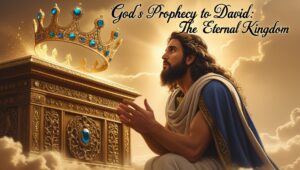
David: The Flawed King Who Reshaped Leadership, Worship, and Warfare
Imagine a man with the fine dust of the Judean wilderness still on his feet and the crushing weight of a gold crown already pressing against his brow. Most of us grew up with the Sunday school version of David—the brave boy who felled a giant—but the historical reality is far more jagged and compelling. He was a “man after God’s own heart,” yet his reign was marked by blood, political intrigue, and a carnality that nearly dismantled his nation.
The real David was a paradox: a lethal artist who composed hymns between battles and a king who found his strength in being “undignified.” Through the lens of Rev. John Schultz’s study, we find a narrative that defies modern leadership tropes. David’s power didn’t come from perfection, but from a proximity to the Divine that few have ever dared to navigate.
2. The “Heart” Myth: Perfection vs. Proximity
We often mistake being a “man after God’s own heart” for flawless moral performance. In the gritty reality of Scripture, this designation had nothing to do with David’s lack of sin and everything to do with his unique desire. David didn’t just follow God; he reminded God of someone else entirely.
“The LORD has sought out a man after his own heart and appointed him leader of his people.”
— 1 Samuel 13:14
Schultz’s analysis reveals a startling truth: David reminded God of His own Son, Jesus Christ. This is why God paid such intense attention to the shepherd boy. David’s worth was found outside himself—in the Messiah. His life proves that God isn’t looking for a clean record, but for a heart that resonates with the eternal character of Christ.
3. The Mastery of Missing: The Slingshot as a Management Tool
David’s skill with the sling is legendary, but its origin was a tool of peace rather than war. He likely refined his craft through interaction with the Benjamites, famous for slinging stones at a hair without missing. Yet for a shepherd, the true “art of slinging” was the ability to miss accurately.
When a sheep began to stray, David would sling a stone near the animal to startle it back to safety. The sling was a management tool—designed to guide, not harm. Only when the context shifted from quiet pasture to battlefield did it become a lethal asset.
4. The Lethal Artist: The Paradox of the Harpist‑Warrior
Modern culture often treats artistic sensitivity as “soft,” but David fused technical excellence with warrior grit. He mastered the kinnor—a ten‑stringed lyre—while rising as a “mighty man of war.” It was the ancient equivalent of a concert pianist who also dominates the football field.
David’s music wasn’t a distraction from battle; it was the source of his tactical brilliance. By playing the kinnor, he penetrated “the recesses of the mysteries of God,” gaining insight into the spiritual forces behind physical conflict. His music allowed him to perceive what armored soldiers could not.
5. The Castle Trap: Why Goliath Was Actually Vulnerable
The Goliath story is often framed as a miracle of the weak defeating the strong. But strategically, Goliath was a victim of his own strength. Encased in a 200‑pound coat of mail and carrying a 25‑pound spearhead, he was a walking fortress—imposing but immobile.
David recognized that the giant’s size and armor were liabilities. A slow-moving target is no match for a spirit‑filled marksman.
“Who is this uncircumcised Philistine that he should defy the armies of the living God?”
— 1 Samuel 17:26
David didn’t merely have faith; he had a clear tactical analysis of the giant’s vulnerability.
6. The Ripple Effect: Why No One Sins Alone
David’s fall with Bathsheba was more than a private moral failure—it marked the beginning of the end of the theocracy. This act of carnality represented a political and spiritual turning point where the “spirit of theocracy” began to fade from the monarchy.
While Schultz notes that “Satan played a role,” the catalyst was David’s own choice to abandon the Spirit for the flesh. The ripple effect devastated his family and left a legacy of consequences that outlived him. Leadership always carries collateral impact; no one sins alone.
7. The Art of the Pause: Waiting vs. Acting
A central theme of David’s life is the strategic necessity of waiting on God’s timing. In the cave at En Gedi, he refused to kill Saul, choosing instead to wait for God to grant him the throne. He understood that seizing a promise by force is the fastest way to lose the blessing attached to it.
Conversely, his greatest failures—such as the unauthorized census or the first attempt to move the Ark—occurred when he acted impulsively. Success in David’s world required spiritual discipline and the “art of the pause.”
“Waiting for God can only be done when one has the conviction that God’s timing is perfect, in spite of what our circumstances… may tell us.”
— Rev. John Schultz, A Study of David
8. Conclusion: The Legacy of the Flawed King
David’s legacy is that of a “linchpin in God’s plan of salvation,” proving that God values integrity of heart and skillful hands over outward appearances. Despite his failures, his willingness to repent redefined what it meant to lead under God.
He was the kind of king who would shed royal dignity to dance before the Ark, prioritizing God’s glory over his own status.
His life forces us to examine our own “armor”—the reputations and protections we build to hide our vulnerabilities. If David’s strength was found in being “undignified” for the sake of faith, what armor are we wearing today that might actually be holding us back?